Thursday, June 21, 2007

The giant ocean sunfish

The ocean sunfish (mola mola) is the largest bony fish in the world. It is a unique pelagic fish, and specimens of ocean sunfish have been observed up to 3.3 m (11 ft) in length and weighing up to 2,300 kg (5,100 lb).

Curiously, the Ocean Sunfish has a very small brain compared to its size: A 200 kg specimen may have a brain the size of a nut weighing only 4 g. It would explain their quiet behaviour and how often they get trapped into fisher nets.

According to the National Geographic if it lives to adulthood, a sunfish can gain over 60 million times its starting weight: "the equivalent of a healthy, bouncing human baby growing to a weight equal to six Titanics".

The images of scuba divers next to a giant sunfish gives us a better idea of their incredible size. Fortunately, ocean sunfishes float serenely in midwater.

Ocean sunfish is generally thought to be solitary fish, swimming freely in the ocean alone. However, certain sightings of molas in groups of more than ten have been reported. Frequently, giant sunfishes lie inert on the ocean surface, apparently sunning themselves.

Sometimes, ocean sunfishes are caught accidentally by fishers nets and a crane is needed to lift them on board.

Another threat to ocean sunfish are floating plastic bags which look like their natural prey, jellyfish. Sunfish can choke as they try to swallow the bags, or slowly starve as the plastic clogs their stomach.


Recently, a Gaza fisherman trapped a giant sunfish. He threw his nets into the water and was surprised when the fish got stuck in five of his nets. His catch measured 3.5 metres or 11 feet in length, 1 metre in width and weighed one tonne. Many fishers have lived the same experience, and it seems pretty impressive.


Some years ago, Australian Museum acquired such a large specimen that they had to use ropes to haul it up and get it inside the building through a window. As you can see, the size of other specimens is as big as a parking place.


On the other hand, giant sunfishes are an important menace for little ships. A collision at high speed can cause both injury to sailors and damage to yachts.


Finally, the flesh of the ocean sunfish contains neurotoxins similar to those of other poisonous tetraodontiformes, but it is considered a delicacy by some people.


Thursday, June 14, 2007

Very Special Visitors.

Whether you are a professional in the diving industry, a hardcore dive every week kind of diver or a vacation diver; the world of scuba allows us to meet all sorts of people. We at Beqa Adventure Divers are fortunate to be able to dive with some of the icons in the world of sharks and last week was no exception.

To our delight, we were privileged to play host to Stan Waterman, Nancy McGhee and their friend John Crossley. Thankfully Stan managed to fit in a whistlestop visit to us in between charters on the Nai'a and Bilikiki.

The last time Stan paid us a visit we were fortunate to get to dive with all 8 species of shark in Shark Reef Marine Reserve. The sharks must have remembered as Dive Day #1 culminated with a visit by not 1, but 2 tiger sharks. Scarface, the largest of the tigers we see was joined by a smaller individual who we have never before observed. The newcomer was much smaller than Scarface coming in at about 10ft in length.

Dive Day #2 and the heat was on to try and match the previous day's diving. Things did not look good when it was revealed that the bringer of bad luck, Andrew, was going to be aboard for the trip... turns out his luck must have changed as again, we had all 8 species of shark. There was a solitary silvertip, 3 sicklefin lemons, tawny nurses, grey reefs, whitetip reefs, blacktip reefs, over 20 bull sharks and another tiger shark. This time it was Adi, our little princess, who decided to put on a show for Stan, Nancy & John.

So, 2 days of diving, 8 species of sharks, lots of stories being shared and it was time to say farewell once more. Safe travels to Stan, Nancy & John and we wish you a safe and exciting trip aboard Bilikiki.

Until next time, from the team here at BAD, a big vinaka vakalevu.

More protection for our Sharks!

Ever since having established the Shark Reef Marine Reserve in 2003, we have been striving to further expand the protected area. As the data provided from our satellite and radio tagging experiments tell us, the Bull sharks and Tiger sharks tend to roam a much larger territory in this region.

The southern coast of Viti Levu adjacent to Shark Reef comprises the Qoliqoli, or fishing grounds, of the Villages of Galoa, Wainyiabia and Deuba.

After more than one year of sometimes difficult negotiations, we have finally succeeded in signing an Agreement with the relevant Chiefs and Mataqali representatives of Deuba Village stipulating that any catching or otherwise harming of Sharks within the entire Qoliqoli of Deuba Village is henceforth banned.

Galoa and Wainyiabia Villages, our partners in the Shark Reef Marine Reserve, have since joined in by also declaring their own entire Qoliqoli to be banned for Shark fishing.

To compensate for any losses in income, Deuba Village will be entitled to a share of the Marine Park Levy collected on Shark Reef, for which the Swiss Shark Foundation is very kindly providing a minimum income guarantee.
To that effect, the Marine Park Levy on Shark Reef has been increased to $20.

In April 2007, the Fiji Department of Fisheries has sanctioned all relevant Agreements, making them legally binding and thus enforceable.

The protected area, which has been named the Fiji Shark Corridor, comprises approx. 30 miles of coastline and thus hugely expands on the original Shark Reef area. In fact, when you visit Shark Reef, the entire coast as far as you can see in either direction is now protected!

Our special thanks go to
- the Villages of Galoa, Wainyiabia and Deuba for their kind assistance in making the above possible
- Manasa Bulivou, our spokesperson, for his tireless Village diplomacy
- Gary Adkison and Dr. Alexander Goldknecht, of the Swiss Shark Foundation, for their unwavering moral and financial support
- Dr. Juerg Brunnschweiler, for collecting the relevant scientific data
- Aisake Batibasaga, Principal Research Officer and Acting CEO, Fiji Department of Fisheries, for his assistance and guidance

Rusi lending a helping hand!

It's not uncommon on The Shark Dive to witness several sharks trailing long lengths of fishing tackle from their mouths. It's very hard to tell whether it is from sport fishing boats, local fishermen or the dreaded longliners; no matter where the hooks originate from though it always means pain and discomfort for the animals.

One of the tiger sharks that we observe, Adi (Princess), showed up 3 weeks ago with one such fish hook lodged in the corner of her mouth. Unfortunately there was not much line for us to work with, a mere 18" extended from her mouth and the hook was clearly visible.

Rusi, one of the shark feeders, took it upon himself to help Adi and remove the fish hook. Adi, at 13ft, is not the largest of tiger sharks but she is still one very large fish. She will approach cautiously at first, checking everything and everyone out ensureing that there is no treat to her; once confident that all is safe Adi will then make close passes of the feeders and take the bait offered up to her.
On one such pass, there was no bait on offer, instead Rusi reached out and plucked the fish hook from the corner of Adi's mouth. Surprisingly she did not flinch ot show any signs of discmfort upon removal of the hook. On subsequent passes Rusi then held up the hook to Adi so she could see what it was that was lodged in her mouth.

Mass Extinction?

"Human beings are currently causing the greatest mass extinction of species since the extinction of the dinosaurs 65 million years ago. If present trends continue one half of all species of life on earth will be extinct in less than 100 years, as a result of habitat destruction, pollution, invasive species, and climate change."
from massextinction.net

Did you know that:

• If current trends continue, one half of all species of life on Earth will be extinct in 100 years. (E.O. Wilson, The Future of Life, p. 102)

• One quarter of all mammal species face extinction in 30 years. (United Nations, http://news.bbc.co.uk/)

• For every person in the world to reach present U.S. levels of consumption we would need 4 more planet Earths. (Wilson, p. 23)

• Humans currently consume 50% of the Earth's available freshwater, leaving what's left over for all other species. (World Wildlife Fund, http://www.panda.org/)

• Humans currently consume 40% of all organic matter produced by photosynthesis on Earth, leaving what's left over for all other species. (Wilson, p. 33)

• Every species of great ape on the Earth (gorillas, orangutans, chimpanzees, and bonobos) is in imminent danger of extiction. (United Nations, http://news.bbc.co.uk/)

• Every species of tiger on Earth is in imminent danger of extinction. (World Wildlife Fund, http://web.archive.org/)

• The number of lions left in Africa has fallen 90% in 20 years -- there are now only 20,000 remaining. (BBC, http://news.bbc.co.uk/)

• 90 percent of all large fishes have disappeared from the world's oceans in the past half century. (Nature Magazine, http://www.cnn.com/)

• Human population is expected to increase by at least 50% over the next 75 years. (United Nations Population Division, http://www.enviroliteracy.org/)

from speciesalliance.org

And what about Sharks?

"By 2017 it is anticipated that 20 species of shark could become extinct due to hunting, indiscriminate fishing techniques and, ultimately, man's greed."

from bite-back.com

So what if we kill them all?


Cascading Effects of the Loss of Apex Predatory Sharks from a Coastal Ocean

Ransom A. Myers, Julia K. Baum, Travis D. Shepherd, Sean P. Powers, Charles H. Peterson


Impacts of chronic overfishing are evident in population depletions worldwide, yet indirect ecosystem effects induced by predator removal from oceanic food webs remain unpredictable.
As abundances of all 11 great sharks that consume other elasmobranchs (rays, skates, and small sharks) fell over the past 35 years, 12 of 14 of these prey species increased in coastal northwest Atlantic ecosystems.
Effects of this community restructuring have cascaded downward from the cownose ray, whose enhanced predation on its bay scallop prey was sufficient to terminate a century-long scallop fishery.
Analogous top-down effects may be a predictable consequence of eliminating entire functional groups of predators.


This is the newest and probably, also the most compelling study about the consequences of Shark overfishing. You can download the full document from the link above and we're also shortly going to post it on our website.

Bad News


"The world's oceans are a shadow of what they once were.
With a few notable exceptions, such as well-managed fisheries in Alaska, Iceland, and New Zealand, the number of fish swimming the seas is a fraction of what it was a century ago. Marine biologists differ on the extent of the decline. Some argue that stocks of many large oceangoing fish have fallen by 80 to 90 percent, while others say the declines have been less steep. But all agree that, in most places, too many boats are chasing too few fish."
From a chilling report by National Geographic.

Got some great pics and video?


Maybe as good as this one by Doug Perrine?
(Incidentally, that was right before Scarface took that nibble at the end of the infamous naughty file! Check out the pic and you'll see how she's already starting to bend back the monitor! )

Give it your best shot (and I mean that literally) and join the "Under the Blue 2007" International Underwater Photo and Video Competition!
We're one of the main sponsors and you might end up getting some more great price-winning shots on The Shark Dive.

But hurry up, submissions close on May 12.

Best of luck and hopefully, see you soon!

Crazy Stuff !


All of you out there who still think that we're crazy, check out this !!!
I cite: "faut vraiment etre debile, le jour ou il tombera sur un requin moins stone on va bien se marrer" - but who am I to say (-:
Enjoy!

New Beachfront Resort Opens its Doors.

As with a lot of things in Fiji, it took a little longer than initially expected; however it was well worth the wait. Opening its doors in February, The Uprising Beach Resort offers beachfront accommodations with unparalleled views over to Beqa Island.

Uprising Resort has 12 traditional bures available, 6 beachfront and 6 garden all set amongst some beautiful tropical foliage. The swimming pool is encircled by an expansive deck that leads to the bar and restaurant and is a short hop, skip & jump from the clear waters of Beqa Lagoon.

So if you're coming to Pacific Harbour, why not take a look at The Uprising as one of your options?

See You at the Long Beach Scuba Show!


Scalyhead Sculphin.2
Originally uploaded by Pixel Letch.
Fantasea Line and I are sharing a booth together at this weekend's Long Beach Scuba Show. We're in booth #737 and will have lots of great photo toys like the new FD80 and FD40x housings, the new CoolPix L10 and L11 as well as the prototype of the new FP5000 housing for the very cool new Nikon CoolPix 10MB P5000 digicam.

Lots of accessories, arms, filters and much more.

All at special show pricing with free shipping this weekend only!

Stop on by and say hi!


Look Honey! It's Diver Jack!

My aquarium dive buddy Tim and I were walking back to our cars after "performing" our feeding show at the Seattle Aquarium today. I worked comms and topside support as I had wanged my eye with a strobe cord yesterday (don't ask), nothing serious, but no diving for a couple of days.

Tired and laden with wet gear I suddenly heard a woman in very excited tones say, "Oh look, it's Diver Jack! Honey, it's Diver Jack. May we take your picture?" Huh? Me??? What'd I do??

Diver Jack is my stage name. We now do feeding shows, talking to the audience, taking questions and showing off the wolf eels and animals when we feed them. The wolfies are my pets and will sit on my head to eat squid. We use full-face Aga masks and comms with surface-supplied air. As part of that, we wave to the crowd, talk to kids, and get people involved, so that we can impart a conservation message.

But I never thought I'd have groupies!

My groupie was cute as a bug, pretty in pink, and about 3 years old. Very excited, Mom asked to take my picture with her daughter Gretchen. I taught Gretchen how to make an "ok" sign. She was so excited she could hardly talk. So was I.

They promised to come to other shows, and it seemed we had both made our afternoons.

The DigiDivers Do Keystone!

I had the great pleasure of finally meeting and diving with Jan Kocian, aka "Honza" at his favorite local spot, Keystone Jetty, where one of the ferries comes in on Whidbey island, here in Puget Sound.

Our club dives there on and off as conditions can be tricky, it is very open to the wind and currents can be strong and un-predictable, even at slack. Even so, it is a very popular state park with great facilities, hot showers even. So I was very surprised when we pulled into the parking lot at 10am and found it completely empty on a Saturday morning. Usually it is jammed up with student divers.

Winds were light and off-shore. Overcast, but no rain. The currents were settling down and as we started to get ready, Jan pulled in and we greeted each other, having had long mutual admiration for each other's work on the various boards including DigiDiver.net. We've traded emails on and off, but never quite connected for a dive.

We looked each other's rigs over and got in the water. Of course the first thing that DigiDivers do is to take pictures. Not of marine-life, but of each other!

Swimming out along the jetty, there was a very slight current pushing us out and then once we kicked through it's back-eddy we were completely out of the current at the end of the jetty. It is usually very strong and can even be somewhat dangerous, as it can sweep un-wary divers around to the other side underneath where the ferry comes in. Not fun, and a long walk back.

I've never seen the conditions so nice and Jan said it had been that way all week. The critters weren't too cooperative, but we shot a few fish and nudis.

All-in-all, a great dive and I enjoyed meeting Jan. I've invited he and his family down for a tour at the Seattle Aquarium and i hope to dive with him again soon!

Here's his commemoration of the event:
The DigiDivers

Here's a link to some of Jan's other work and a bit more about him: REEF - Jan's Creations

Willy Volk Surfaces

My good friend Willy Volk late of Divester fame has surfaced again in a new diving blog that everyone should bookmark a feed from.

The new X-Ray Magazine blog is tied to the equally excellent e-magazine to which I was a contributor of a section on PNW diving (they don't seem to publish me anymore, sniff).

X-Ray Magazine, "is an awesome magazine about scuba diving with a truly international focus. This blog is designed to complement the magazine. Check in often for interesting scuba news from around the world. If you've got a news tip, we'd love to get it. Send tips to: willy@xray-magDOTcom." according to the blog.

Divester was killed by AOL, but Willy remains on staff now writing for the travel blog Gadling, which is also worth bookmarking.

Five Tips for Better Underwater Photography

This is the second monthly column written for NW Dive News Previous column: Getting Started in UW Photography


Have a Conversation!
Originally uploaded by Pixel Letch.
Got a new underwater camera? Photos not quite up to snuff? Here are 5 quick tips to help you out.

Tip #1. Get close, have a conversation. If you think you are close, get closer. Two to four feet away is where most digicams shine. Many have a macro setting that can focus the lens from 1" to 4'. That’s the setting to use most of the time, as it is the perfect range for your strobe and for best sharpness. Remember that the more water you have between the camera and the subject, the less sharp and vivid your shots. But be careful in getting too close, there is a point where cameras cannot focus, check your manual.

Try to capture the head and eyes of your critters. Have a conversation with them, just like when you meet someone and shake hands.

Tip #2. Shoot up. Use the available light to help light your backgrounds for "reefscapes".

Tip #3. You can't light everything. In combination with Rule #1 & 2, try a type of shot called a close-focus, wide-angle.

Get close to say one fish, a nice outcropping of coral, or an anemone. Light that with your strobe. Point at an upwards angle, setting your camera on auto, or meter the water column and select a slower shutter speed (not any lower than 1/60th) to let the available light open up the background. Center the subject and take a half squeeze on the trigger to focus. With your finger still holding the half-press, re-compose with the subject close and to the side, maybe lower in the frame. Hold your camera steady and squeeze the trigger the rest of the way. Now you have a nice shot of a subject and it's environment giving greater depth and drama.

Tip #4. Macro. To get a nice black background, use your strobe in TTL, or auto, and increase your shutter speed. Set it as fast as possible, with a low ISO for sharpness and the strobe as close as possible to the subject for the best color saturation. You may have to turn the power down and use a diffuser to soften the light.

The background is always controlled with shutter speed. Want to open it up? Shoot slower. Want it blacker? Shoot faster. Can't get what you want? Adjust strobe power or position so you can work with it. Close in is where TTL usually shines. If you’re shooting in mid-water, you'll do better with manual strobe settings.

Tip #5. In-between. What about fish portraits and buddy shots? Set your camera to manual, or on program mode. Set an aperture somewhere in the middle (maybe f4) and shutter speed to as slow as you can hold, usually about 1/60th. Increase the strobe power or use TTL/auto.

Set the ISO as slow as possible. Remember, higher ISO means more noise, seen as fuzziness. Set it at ISO 100, or lower, for macro. For other shots, try to not go above 200 to 400.

On digicams where you don't need the depth of field, the middle aperture setting (f4) gives the best sharpness. This is due to the very small actual apertures on these lenses and the way light waves pass through them.

Tip #6. Break the rules! Hey, you said 5 tips. Well, the sixth is simply to break the rules. Try things out. Experiment. Many times the best shots come from bending, breaking, and creating your own rules. Look at your mistakes carefully, learn from them and try another variation.

Have fun with underwater photography, the more you shoot, the better your shots will get!

--------------
Jack Connick is a Seattle diver and graphic designer who always wanted to be a photographer. He writes a blog, Optical Ocean on diving, sailing and underwater photography, and has traveled extensively around the world, logging around 700 dives in ten countries.

His company Optical Ocean Sales.com, is an authorized dealer for Fantasea Line underwater photography products.

Visit and join his free Cold Water Diving Flickr photo group.

Junkyard Dogs


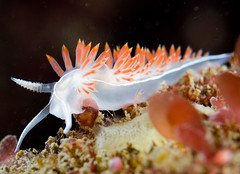
Red Flabellina
Originally uploaded by Pixel Letch.
Randy, Jim and I dove the wickedly tricky Alki Junkyard on a photo op yesterday around 4pm. The rain had let up and conditions were quite easy. Parking even became available as we pulled up.

An easy swim out to the white buoy with a blue stripe landed us in junkyard central. I have to say this is one of the best macro sites I've seen around here. It was loaded with small fish, anenomes and most of all - nudibranchs!

I quickly spotted Janolus fuscus, Flabellina trophina, and found a very cool Armina californica out on the sand. Or; a clear one with yellow dots, red with white dots and a striped nudibranch. The later is one I'd never seen before, mostly because it is a burrowing nudibranch that feeds on sea pens. Even stranger is that it has no external gills on its behind like most do.

Everything was pretty small though; many the size of a quarter or half dollar. I could of used a 100mm macro lens as opposed to my new 60mm I was trying out on the new D80/Fantasea rig.

The current picked up while we were out and shooting out on the flat became hard. Everything wanted to go into the current and I couldn't get ahead of it to get "face" shots. But there were a few piles of junk that you could hide behind, and I found some scaly-headed sculphins there, always a crowd pleaser with their green eyes.

We spotted lots of crabs and shell middens, but no octos, but they sure looked like they'd been around recently. Also spotted "dinner" several large male dungeness crabs up in the shallows.

We didn't go far up into the current, staying at 50' or so the entire dive as a result we had a long hour dive, Randy did 70 mins.

This is a great photo friendly site with easy access, no rocks to trip over and a wall to set your rig on after the dive.

Photos are here.

iNova DSLR E-Books

I recently bought the iNova E-Book for the Nikon D-80. Even though I thought I knew a fair amount about color and digital technology, the book gave me a much better, up-to-date understanding. It then went over the camera, how to use it, tips and techniques and lens and strobes - in much greater detail and clarity than the user guide.
I think these are some of the best manuals/instruction books available for any photographer, advanced or beginner. The content is stunning, easy to use, and uses Acrobat technology to show you in much greater detail and interactivity how to utilize your camera. They are available for the Nikon D70, D80, D200 (soon D40) and the Canon 350 and 20. Get up to speed much faster without dealing with a OEM manual written in 4 languages, none of which you speak!
They include both high and low rez files, a printed instruction book, plus 624 iNovaFX Actions, that are in themselves enough to pay for the cd.

The DSLR series of eBooks was born of a necessity. The majority of photography books are basics, expansions on manuals, dry, procedural, technical and generalized. As a group, they don't give you the understanding and immediate tools to better your images with your particular camera and lens, highlighting the unique opportunities, qualities, controls, menu items and synergistic combinations that were there for you, if only you had known.
What we really need is a knowledgeable friend looking over our shoulders as we shoot, advising, chiding, challenging and bantering in creative ways, but after some research, we found that providing this as a service would be cost-prohibitive. So we made digital photography's first eBooks.
Photography can be technical. Pixels and photons, hyperfocal distance and guide numbers. It's enough to make you scream. But all that stuff is worth knowing about -- or skimming through -- so we make sure it's in there in a form that is easy to digest, or dig into if you feel like a meal. Animated examples, interactive illustrations and embedded movies bring the most opaque subjects into clarity. We feel it's our job to lift your eyebrows with interesting things on every page.

Click for more info. Get free shipping when you order!

Getting Started in Underwater Photography

I’ll be writing a monthly column for Northwest Dive News on underwater photography, one of the most popular activities in diving today . I’ll be concentrating on cold-water dive photography which has it's own set of skills and equipment. Tips, tricks, gear and local dive sites, I’ll try to touch on them all and more.

I’ll re-print them here monthly in my blog, with a little more room for explanations and photos.

Your Experience Level and Guarding Against Task-Loading
Before we "dive" in, lets do a quick review of dive skills and experience necessary for your safety and the protection of the natural environment that you want to photograph. You need to have excellent buoyancy skills with intuitive, well-practiced, abilities as a diver to get into dive photography. I feel that it takes most new divers between 50-100 cold-water dives, because you will be adding a lot of task-loading and additional skills.

Not having this experience can result in damaging a reef, or more dangerously, an unsafe situation for you. You should feel that diving is intuitive to you and not have to think about it too much.

That doesn't mean that you can't buy your camera and become just as intuitive with your camera skills while you gain diving experience. It's a little tough to read a manual when you're 60 feet under water, so knowing your camera well really helps.

A hidden danger to a dive photographer, particularly in cold-water, is task loading beyond your experience level, or what the diving conditions can dictate. If in doubt, leave the camera topside, explore and shoot another time. Dive safety and protection of the underwater environment must come first!

Getting Started
Diver-photographers are faced with a bewildering assortment of cameras and options when it comes to buying a camera. Digital camera technology seems to change every day. Rather than just buying something that looks cool, or that a salesman recommends, I’d suggest a more methodical approach.

  • What do you want to do with your photos?
    Use them on a website or in emails? Print snapshots, or large wall-prints? Maybe see your work published?
  • How much do you want to grow your system? Are you starting out with a digicam and thinking about growing into a DSLR system later, or is your use more casual, capturing a few shots from a dive trip for fun?
  • Where are you going to be shooting? Tropical or cold water? Working controls with gloves on, strong strobes and having durable equipment is important here in the Pacific Northwest. In tropical waters a lighter, smaller system may work fine for you and be easier to pack and carry.
  • What do you like to shoot?Macro? Fish-portraits, maybe a close up of your buddy? Or do you want to “shoot up the reef” and do wide-angle shots?
  • Do you want a camera for above-water, as well as underwater, use? How well supported is it, can it take good top-side photos as well?
  • How much are you planning on upgrading in the near future?What strobes will it connect to? External lenses and other add-ons? Can they be used with other cameras and systems?
    And, oh yeah, how much are you able to spend? This is not a cheap hobby, and you pretty much get what you pay for.


My Recommendations
I generally recommend a camera and housing as opposed to an amphibious camera, or dedicated camera/housing solution. Canon, Olympus, Fuji and Nikon build an amazing amount of cameras and many can be used very successfully underwater in a housing. The competition between these companies means that their feature-sets and technical advances are changing much faster than dedicated underwater cameras. Plus, there are more housings, external equipment and third-party solutions available, that can be moved to an upgraded system later. Simply put, they are a better value and can be used well above water too.

There are some very good, dedicated amphibious cameras; some have good controls and a sharp lens. They are smaller to carry and simpler to use, but you'll be at the higher price range to get the control and quality you want. I think housed systems offer more quality for less money.

My company Optical Ocean Sales.com, is an authorized dealer for Fantasea Line underwater photography products, which makes housings for Nikon CoolPix digicams and DSLR housings for Nikon, Canon and Olympus. I really like the CoolPix P3 and the Nikon D80 or Canon xTi 400 for underwater use.

Make sure whatever camera you buy, that you have as much manual control as possible. Why? Because most automatic camera features are not designed for the low light conditions you find underwater. Also with an external strobe, you’ll need to use manual or aperture/shutter priority modes to adjust your strobe exposure.

Whatever camera you have, my best advice is to get out there and shoot! Practice does make perfect!

Next Column: 5 Tips for Better UW photos

Seattle Aquarium Expansion Construction


Windows on Washington tank
I was privileged today to get a behind-the-scenes tour of the expansion and renovation project at the Seattle Aquarium where I am a volunteer diver. Because of safety issues, it's been a closed door to all, but the director John Baden led some of us through so we could get a better idea of how things were progressing, and what the $42 million project was going to look like when it opens in June. Here's a description from their website:
The impact of the New Currents Campaign will expand the Aquarium by 18,000 square feet to include a fresh new exterior, new Alaskan Way entrance and exhibit hall. At the heart of the expansion will be the Puget Sound Great Hall, a three story, light-filled building with interactive educational kiosks, sea life art and thought-provoking conservation exhibits focused on Puget Sound ’s ecosystems. Visitors will immediately be drawn to the end of Puget Sound Hall by the Window on Washington Waters, a 17-foot by 39-foot, 120,000 gallon showcase exhibit evoking Neah Bay’s rock blades filled with salmon, colorful rockfish, vibrant sea anemones and other marine life swimming amid a kelp-filled sea. New visitor amenities will include a full-service café and gift store, member entrance, additional ticketing stations and second floor viewing platforms for a three-dimensional look into Window on Washington Waters. A separate school group entrance will provide quick access for the increasing number of students and teachers who visit the Aquarium. The transition hall between the Windows on Washington Water exhibit to the tidal waters of the Life on the Edge exhibit will feature an open 40-foot by 8-foot Wave Tank allowing visitors the opportunity to hear the surging waves and observe how marine animals and plants survive in swirling, rough water.
Yes, we're going to dive in that tank!

Rusty? Nah, Not Us!

My Dive buddy Ed "Doc" Kay rounded up the six of us for a boat dive last Saturday to Waterman Wall on the west entrance to Rich Passage, near Port Orchard and Bremerton. We loaded up and got underway at about 10am and made quick time in calming conditions across the sound. The cloud cover came over us, but it was pretty nice overall, considering we'd had snow as late as last Monday. Definately "wait-a-minute" northwest weather.

Waterman Wall a very nice dive, but has some strong currents and can have a downdraft on the ebb, so it's an advanced+ dive. One story goes that a guy was lost there and the only thing they found was an empty "spare air" on one of the rocky shelves. Normally I've dove it from the east side on the end of the flood, this time we were diving on the end ebb, so we anchored on the west side of the light.

We got suited up "and waited just a bit for the tide to turn. I gave a quick brief, I knew the wall extended to the light from the east, but wasn't sure how far past it west it extends - turns out it keeps going for a while. We probably could of gotten in a little earlier, but "DiveAlert" Dave got in with his rebreather and scooter first, followed by another team of Kevin and Delores. I was being a good guide to the site and had helped Delores not to forget her drysuit inflator hose connection.

But Paul, Ed and I were just a bit rusty getting into our gear, not having really dove in a couple of months. The best was Paul; he jumped in without his fins on, then after getting them on we turned around to find him trying to hand up his tank, as the BC dump hose had gotten cross-threaded and wouldn't hold air. That was corrected and he was finally ready for his second attempt to dive. Ed fussed around for quite a while with crossed hoses and lights, while I found that my canister light had been left at home. Luckily Ed had a good spare on board.

Now it was my turn to jump off, everything seemed fine, but as I descended I kept punching my chest inflator to find that I had left my inflator hose disconnected. I put it on after a good squeeze at 35' with Paul's help. Gees, the 3 Stooges Go Diving...

Our team shared a scooter and I easily pulled the 3 of us out to the wall making up for some lost time. It was completely slack. Paul peeled off and Doc and I continued our dive, enjoying the craggy wall. Vis, while pretty good up shallower, was very poor at 70' on down, probably because of the big mornign tide exchange. We hit 98 feet for a few minutes and made our way back up to 70-80' for most of the rest of the dive.There were lots of huge male Lingcod on eggs, some easily in the 5' range. We saw one bright vermilion one in a hole. Lot of rockfish and invertebrates. The other teams found the one resident old wolf eel at 85', but we missed him.

The tide had turned and I again pulled us up-current for a while with the scooter, then we drifted back. Ed and I shared the scooter and he found out the hard way that it's easy to get task loaded with the bulky device, as he floated away from me and didn't stop his ascent until 20'.

I continued solo back up to the east bay where we had anchored and spotted a very nice Bay Pipefish and a few nudibranchs in the shallows.

Back on board we found that while we had dove the sun broke out and we sat on the boat enjoying a few beers with our lunch while a pair of eagles stood guard. What a treat, after the awful winter we've had!

Photos at: Wall Surface Shots

New Flickr Group: Cold Water Diving


Tube Worms & Ed
Originally uploaded by Pixel Letch.
I've started a Flickr group to discuss and post photos taken in temperate to cold water conditions. Dealing with a dry suit and shooting photos can be tricky. What are your tips and tricks? Post your best shots!

It is public, but you have to be a Flickr member to join.

Flickr: Cold Water Diving Group

Jack

Wednesday, December 27, 2006

Now For Something Completely Different


Red Rock Canyon
Originally uploaded by Pixel Letch.
Decided to take a break from Seattle drizzle and cold and go to the desert for the holidays to see some friends. Took along my new Nikon D80 system and have been having fun shooting some scenery.

We went up to Sedona for Christmas and was able to go out to shoot some of the beautiful red rock formations for which the area is famous.


I've been shooting with my new lenses; Sigma 17-70mm f/3.5 Macro, 70-300 f4.5 APO Macro and Nikon 50mm f/1.8. I bought a polarizing filter for the 17-70 and was quite pleased with the dramatic skies and color. The only bummer was when i somehow got a watterspot onthe filter and didn't see it on the last day's shooting. I'm hoping I can fix the spot in Photoshop.

Sunday, June 10, 2007

Great white shark

Classification

Kingdom Animalia
Plylum Chordata SubPhylum Vertebrata
Class Chrondrichthyes SubClass Elasmobranchii
Order Lamniformes
Family Lamnidae
Genus Carchardon
Species carcharias


People’s Fear of Sharks

Many people have a big fear of sharks, especially Great Whites. A lot of this comes from movies like Jaws - which is based on a number of attacks that really happened in New Jersey in 1916. Some people think that there are tons of sharks waiting to eat them if they venture out into the ocean, which is simply not true. Sharks rarely ever eat humans and are solitary animals. They either travel alone or in groups of two.


This image is from www.eng.utoledo.edu/~lcendere/gw/pics.htm


Shark attacks are quite rare, in the US there are two to three non-fatal attacks on swimmers, surfers, and divers per year. By the number of reported incidents, Dogs kill more people each year than Great Whites have killed in the last 100 years. There are lots of divers who swim with sharks and are not attacked. In fact, there are places where you can be guided on a dive with sharks after just one dive lesson. They get used to people and get quite tame. Sharks are misunderstood animals.


Physical Appearance

Great White Sharks are a very large species of shark. They are streamlined swimmers, and have a torpedo-shaped body with a pointed snout.

They have about 3000 teeth, arranged in several rows. The first two rows of teeth are used for grabbing and cutting prey, while the teeth in the last rows rotate into place when front teeth are broken, worn down, or fall out. The teeth are triangularly shaped with serrations on the edges.

The back of the shark is a dull grey colour and the underside is coloured white. They have three main fins: the dorsal (on back) and two pectoral fins (on the sides). The tail is crescent shaped. There are five gill slits on Great White Sharks.

Most of the largest sharks are found in South Australia. The largest one ever recorded was 6.4m (21ft) long, and weighed 3312kg! The maximum length able to grow is thought to be 25ft. Though some people claim to have seen sharks as long as 31ft. The smallest Great White shark caught was 47inches long, but was newly born.
An encounter with a Great White

In the magazine, "Sharks and Divers #1" (Sept. 1997) Jeremiah Sullivan had some great experiences swimming with Great Whites off South Australia. There are some amazing pictures, one of him holding the tail of a 16ft shark and him being towed around.
This is an exerpt of what he said:
"Soon, I was so close to him I could stroke his torso as he swam by – he seemed quite unconcerned. On his next pass I tested him further by hooking my right hand around the upper lobe of this tail. When his momentum jerked me into his slipstream, he didn’t so much as flinch…the only acknowledgement of my presence was a slight but very deliberate glance over his right side as he towed me out to sea…I turned and began swimming with all my strength towards the cage…I remember cursing myself for not calculating this risk a little more carefully…I turned towards the big boy…everything was quiet…He cruised up, looked at me sideways and appeared to say, ‘Oh, Jeremiah, it’s you!’"

Five more times that afternoon shark and man interacted. There were three Great Whites at the site that afternoon. The sharks had every chance to attack, but didn’t.

Food

Sharks are important predators in the marine ecosystem. Their favorite prey are seals and sea lions. As juveniles they eat fish, and rays. When they become full grown they eat marine animals such as whales, seals, dolphins, large tuna fish, sea otters, and dead animals that they find floating on the surface. In order to catch its food a shark will go along the sea bottom and look for shapes at the surface. If it sees something similar to the shape of a seal they charge full speed. They ram the prey and give it a first bite all in one motion, which stuns and injures the prey. It then disappears and allows the prey to bleed to death. When it’s certain the prey’s dead it begins to feed. Sharks don’t chew their food, they just rip it into mouth-sized pieces and swallow it whole. A big meal can last a shark up to two months
Habitat

Great White Sharks live in all coastal temperate waters, and have been known to occasionally make dives into the deep water of open oceans. They can be found in water as shallow as three feet deep, and as deep as 1280metres. They can be found on the following coaslines: California to Alaska, the east coast of the USA, most of the Gulf coast, Hawaii, most of South America, South Africa, Australia (except the north coast), New Zealand, Mediterranean Sea, West Africa to Scandinavia, Japan, and the eastern coastline of China to Russia.
Reproduction

These sharks are ovoniparous, they give birth to 2-14 fully formed pups which are up to 1.5m (5ft) long. Fertilization of the eggs occurs in the female, and later the eggs actually hatch within the female. The young are nourished by eating unfertilized eggs and smaller siblings in the womb. There is no placenta with which they can get nourishment from their mother; they must fend for themselves. The female gives birth to live young, unlike many other sharks who lay eggs. The newborn gets no help from its mother. As soon as it’s born it swims away to begin living its life. A newborn is about 4ft long, and it grows 25cm (10inches) each year, reaching maturity at 10 years.
Senses

Sharks have some of the most highly developed senses of any creature. Their primary sense is the ability to smell. The nostrils can smell a drop a blood in 100 liters (25 gallons) of water. Their next important sense is the ability to detect electric charges. They can pick up electrical charges as small as 0.005 microvolts. The prey can be detected by the electrical field generated by a beating heart or gill action. Fish in hiding can also be detected this way.


Some females migrate to warmer water to give birth in the fall.
A Shark in Captivity

Great White Sharks aren’t usually kept in captivity. Most of the time, they are brought in because they are injured or sick, and they do not usually survive long. One healthy shark, nicknamed Sandy, was brought into captivity in 1980. She was a 7.5ft Great White and was brought to the Steinhart Aquarium in San Francisco, USA. The aquarium was donut-shaped, and visitors watched from a central viewing area. The tank was set up for fast swimming fish, with a current going around against which the fish swam. It was a good environment for a young shark. The caretakers said there were many ups and downs to having her stay there. She showed little interest in divers who went down into her tank.

They soon noticed that she often bumped her nose against the same metal seams in the tank that stuck out about 4inches. So to solve this they put a plastic covering over them to flatten out the seams. Then they noticed that she swam differently at one spot in the tank. At first nothing was detected, but then they realized that there was a tiny change in electrical activity, only 0.125 millivolts – most other sharks and fish wouldn’t have noticed it. They concluded that the only way to fix the problem was to drain the tank, and she would die if she kept bumping her head, so they let her go back into the wild.

My First Post

HEllo world

My First Post

HEllo world